Sarcoma is a rare type of cancer, accounting for around 1% of all adult cancers and about 15–20% of childhood cancers. Because it is uncommon, many people have never heard of it until they or someone they know receives a diagnosis. Unfortunately, this lack of awareness has led to several misconceptions that can delay diagnosis or create unnecessary anxiety.
This Sarcoma Awareness Month, we’re separating fact from fiction by explaining ten common myths about sarcoma.
Myth 1: Sarcoma is just another type of skin cancer.
Fact: Sarcoma is completely different from skin cancer.
Most cancers develop in organs or tissues such as the breast, lung, bowel, or skin. These are known as carcinomas because they begin in epithelial cells that line the body’s surfaces and organs.
Sarcomas, on the other hand, develop in the body’s connective tissues. These include bones, muscles, fat, tendons, cartilage, nerves, and blood vessels. Because connective tissue exists throughout the body, sarcomas can develop almost anywhere.
There are more than 100 different subtypes of sarcoma, each with its own characteristics and treatment approach. This diversity is one reason why diagnosis and management often require specialist expertise.
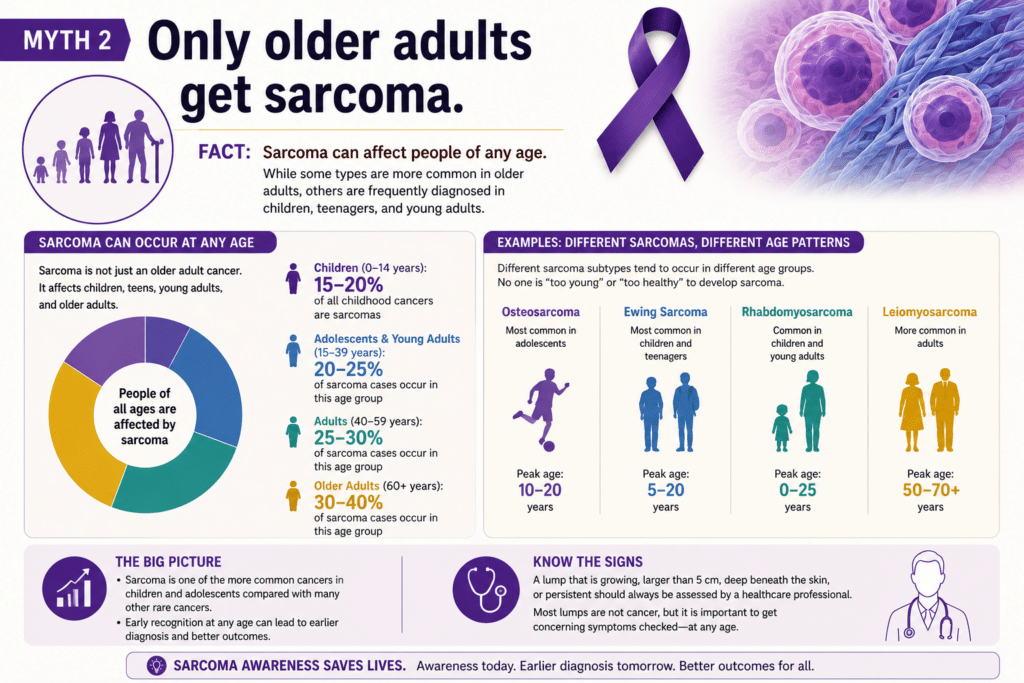
Myth 2: Only older adults get sarcoma.
Fact: Sarcoma can affect people of any age.
While some types are more common in older adults, others are frequently diagnosed in children, teenagers, and young adults. In fact, sarcoma is one of the more common cancers diagnosed in children and adolescents compared with many other rare cancers.
Different age groups tend to develop different sarcoma subtypes. For example, osteosarcoma is more common during adolescence, while leiomyosarcoma is typically seen in adults.
The important message is that no one is “too young” or “too healthy” to develop sarcoma.
Myth 3: If a lump doesn’t hurt, it can’t be cancer.
Fact: Many sarcomas are painless in their early stages.
One of the most common warning signs of a soft tissue sarcoma is a lump that slowly increases in size but causes little or no pain. Because it doesn’t hurt, people may assume it is simply a cyst, lipoma, or sports injury and delay seeking medical advice.
While the vast majority of lumps are not cancer, certain features deserve medical assessment, including:
- A lump that is growing.
- A lump larger than about 5 cm (roughly the size of a golf ball).
- A lump located deep beneath the skin.
- A lump that returns after being removed.
These features do not necessarily mean a lump is cancerous, but they do warrant evaluation by a healthcare professional.
Myth 4: Sarcoma is hereditary.
Fact: Most sarcomas are not inherited.
Many people worry that a diagnosis means their children or other family members are at high risk. Fortunately, this is usually not the case.
Most sarcomas occur by chance and are not linked to an inherited genetic condition. A small proportion are associated with rare inherited syndromes, such as Li-Fraumeni syndrome or neurofibromatosis type 1, but these account for only a minority of cases.
If there is a strong family history of cancer or multiple relatives with rare cancers, a healthcare professional may recommend genetic counselling. However, for most families, sarcoma is not something that is passed from one generation to the next.
Myth 5: A biopsy makes cancer spread.
Fact: This is one of the oldest and most persistent cancer myths and it is not supported by evidence.
A biopsy is the most reliable way to diagnose sarcoma. It involves removing a small sample of tissue so that pathologists can examine it under a microscope and perform additional laboratory tests if needed.
When performed by experienced specialists using appropriate techniques, a biopsy does not increase the risk of the cancer spreading. In fact, obtaining an accurate diagnosis before treatment is one of the most important steps in ensuring patients receive the right care.
This is why suspected sarcomas are often referred to specialist centres where the biopsy can be carefully planned as part of the overall treatment strategy.
Myth 6: All sarcomas are the same.
Fact: Sarcoma is not a single disease.
The term “sarcoma” describes a large family of cancers rather than one condition. There are more than 100 recognised subtypes, each with unique biological features, patterns of growth, and responses to treatment.
Some arise in bone, while others develop in soft tissues. Some grow slowly over many years, whereas others are more aggressive and require prompt treatment.
Advances in medical research have also shown that many sarcomas have distinct genetic changes that help doctors classify them more accurately and guide treatment decisions.
Myth 7: Surgery is the only treatment.
Fact: Treatment depends on the individual patient and the type of sarcoma.
Surgery is often the main treatment for localised sarcoma, but it is rarely the only option.
Depending on the tumour type, size, location, and stage, treatment may also include:
- Radiotherapy to reduce the risk of recurrence.
- Chemotherapy for selected sarcoma subtypes.
- Targeted therapies for cancers with specific molecular changes.
- Participation in clinical trials evaluating promising new treatments.
Every treatment plan is tailored to the individual, which is why care from a multidisciplinary sarcoma team is so important.
Myth 8: Sarcoma always starts in the bone.
Fact: Most sarcomas develop in soft tissues.
When many people hear the word “sarcoma,” they think of bone cancer. However, soft tissue sarcomas are much more common than bone sarcomas.
Soft tissue sarcomas can develop in muscles, fat, connective tissue, blood vessels, nerves, or tendons. They may occur in the arms, legs, abdomen, chest, or almost anywhere else in the body.
Bone sarcomas, such as osteosarcoma and Ewing sarcoma, represent only a small proportion of all sarcoma diagnoses.
Myth 9: Rare means untreatable.
Fact: Being rare does not mean there is no hope.
Although sarcoma is uncommon, treatment outcomes have improved considerably over recent decades thanks to advances in surgery, radiotherapy, chemotherapy, imaging, and molecular diagnostics.
Many people with localised sarcoma are successfully treated, particularly when the disease is diagnosed early. Even for advanced disease, ongoing research continues to expand treatment options and improve quality of life.
Patients treated at specialist sarcoma centres often benefit from multidisciplinary expertise, access to clinical trials, and highly experienced healthcare teams.
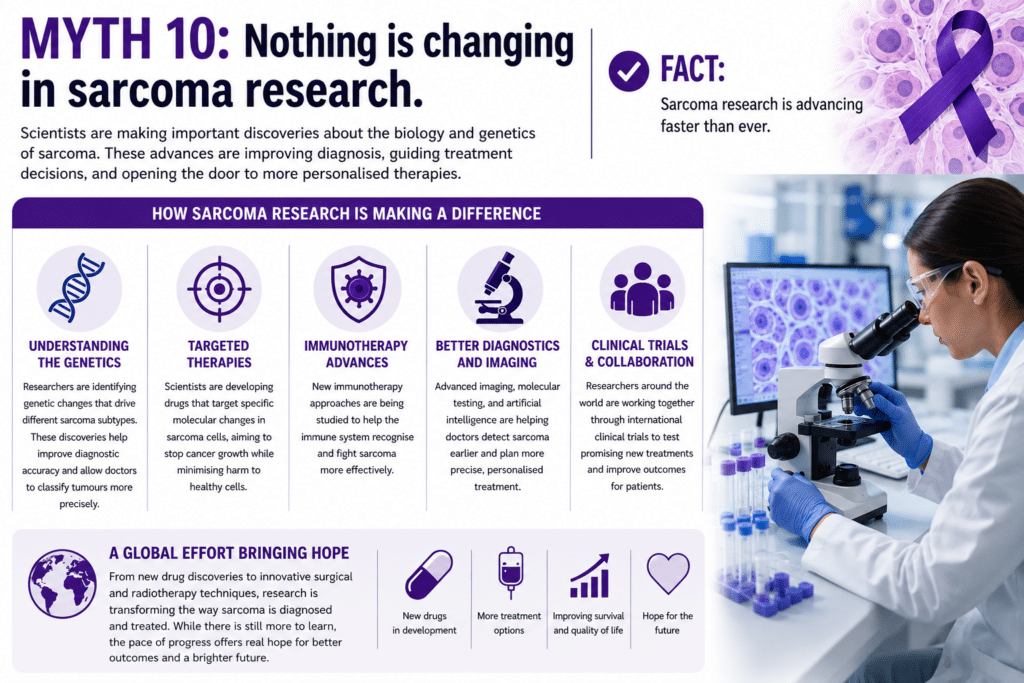
Myth 10: Nothing is changing in sarcoma research.
Fact: Sarcoma research is advancing faster than ever.
Scientists are making important discoveries about the biology of sarcoma, including the genetic changes that drive different tumour types. These advances are improving diagnostic accuracy and helping researchers develop more personalised treatments.
Modern laboratory techniques can identify specific genetic alterations that help distinguish between sarcoma subtypes and, in some cases, guide treatment decisions.
Researchers around the world are also studying immunotherapy, targeted medicines, artificial intelligence in pathology, and new surgical and radiotherapy techniques. While there is still much to learn, the pace of progress offers genuine hope for the future.
Why Awareness Matters
Because sarcoma is rare, awareness remains one of the greatest challenges. Many people and even some healthcare professionals may not immediately recognise the symptoms, which can contribute to delays in diagnosis. Knowing the warning signs can make a difference. A lump that is growing, larger than 5 cm, deep beneath the skin, or persistent should always be assessed by a healthcare professional. Most lumps are not cancer, but it is important to have concerning symptoms evaluated rather than ignored.
Final Thoughts
Sarcoma may be rare, but every diagnosis matters. By challenging common myths and sharing accurate information, we can help more people recognise potential symptoms, seek medical advice sooner, and better understand this diverse group of cancers. Sarcoma Awareness Month is an opportunity to educate, support patients and families, and recognise the remarkable work of clinicians, researchers, and advocates who continue to improve outcomes for people affected by sarcoma. Greater awareness today can lead to earlier diagnoses, better treatments, and more hope for tomorrow.
#HarryKazmiFoundation #SarcomaAwareness #SarcomaAwarenessMonth #RareCancer #CancerAwareness #ChildhoodCancer