
An introduction to the rare group of cancers that develop in bone and connective tissues, and why awareness matters.
As we mark Sarcoma Awareness Month, the Harry Kazmi Foundation is launching a series of articles to help raise awareness of one of the world’s rarest and least understood groups of cancers. Throughout the month, we will explore the different types of sarcoma, current treatments, emerging research and the experiences of those affected. We begin with the most important question of all: What is sarcoma?
Sarcoma is not a single disease. It is the collective name for a diverse group of more than 100 rare cancers that develop in the body’s connective tissues. These are the tissues that provide structure, support and movement throughout the body and include bone, muscle, fat, cartilage, tendons, ligaments, blood vessels and nerves.
Unlike the more common cancers that begin in organs such as the breast, lung, bowel or prostate, sarcomas can develop almost anywhere in the body. They may occur in the arms or legs, pelvis, chest, abdomen, head and neck, or around internal organs. Because connective tissues are found throughout the body, no single part of the body is exempt.
Although sarcomas account for only around 1% of all adult cancers, they represent a significant proportion of cancers diagnosed in children, teenagers and young adults. Their rarity means that many people have never heard of sarcoma until they or someone close to them receives a diagnosis. Even healthcare professionals working outside specialist cancer services may encounter very few cases during their careers, which can contribute to delays in recognition and referral.
A diverse family of cancers
One of the reasons sarcoma can be difficult to understand is that it is not one disease with one treatment. Instead, it is a family of cancers that differ in where they develop, how they behave, how quickly they grow and how they respond to treatment.
Some sarcomas grow slowly over many years, while others are highly aggressive and require urgent, intensive treatment. Some are most diagnosed in young children, others in teenagers and young adults, and some occur predominantly in older adults. This diversity means that every diagnosis is unique, and treatment plans are tailored to the individual patient.
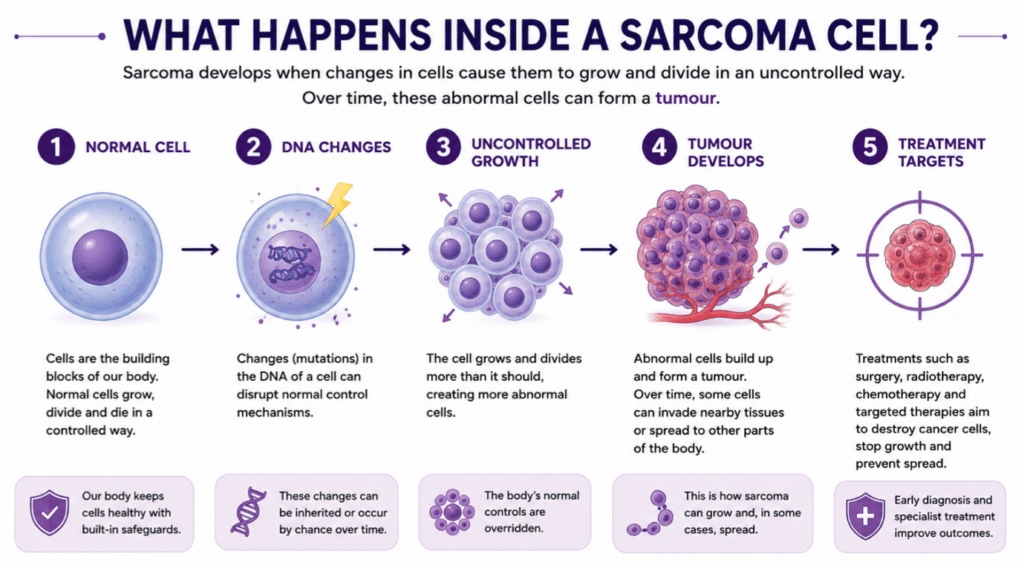
Over recent decades, scientists have discovered that many sarcomas also differ at the molecular level. Changes in DNA, chromosomes and gene fusions can influence how a tumour develops and behaves. These discoveries have transformed the classification of sarcoma and are helping researchers develop increasingly personalised approaches to treatment.
The two main categories of Sarcoma
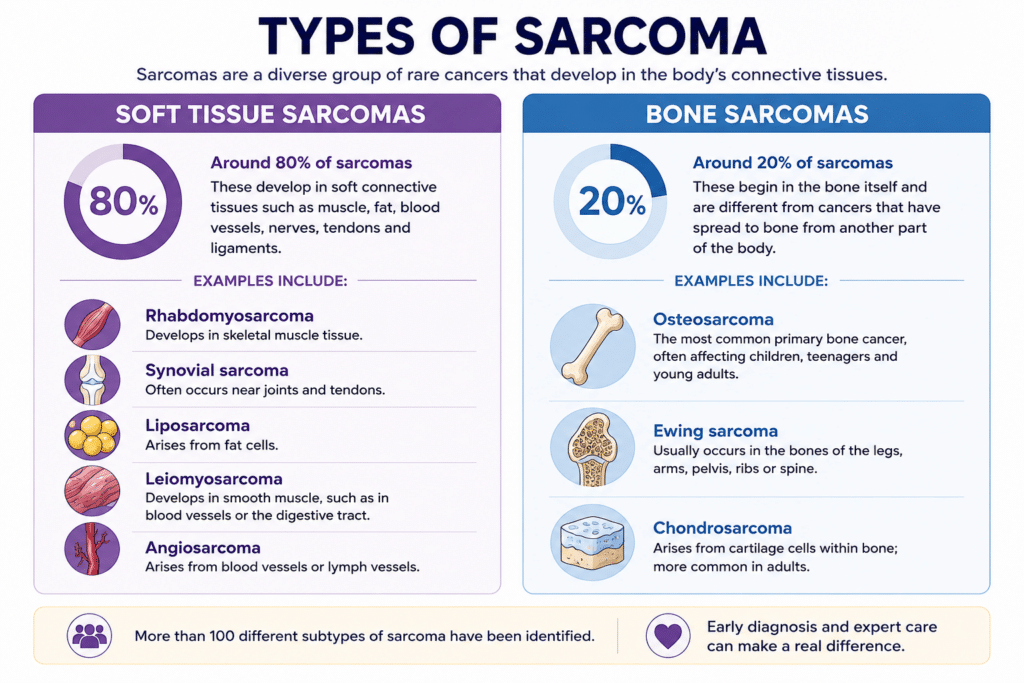
Sarcomas are broadly divided into two main groups: soft tissue sarcomas and bone sarcomas. Soft tissue sarcomas account for approximately 80% of all sarcoma diagnoses. They develop in muscles, fat, fibrous tissue, tendons, ligaments, blood vessels and peripheral nerves. Some of the better-known soft tissue sarcomas include rhabdomyosarcoma, synovial sarcoma, liposarcoma, leiomyosarcoma and angiosarcoma.
Bone sarcomas account for the remaining 20% of diagnoses and originate within the bone itself. They are different from cancers that have spread to the bones from another part of the body. The most common primary bone sarcomas include osteosarcoma, Ewing sarcoma and chondrosarcoma. Each of these cancers has its own biological characteristics, preferred sites within the body, age distribution and recommended treatment pathway.
Why are Sarcomas difficult to diagnose?
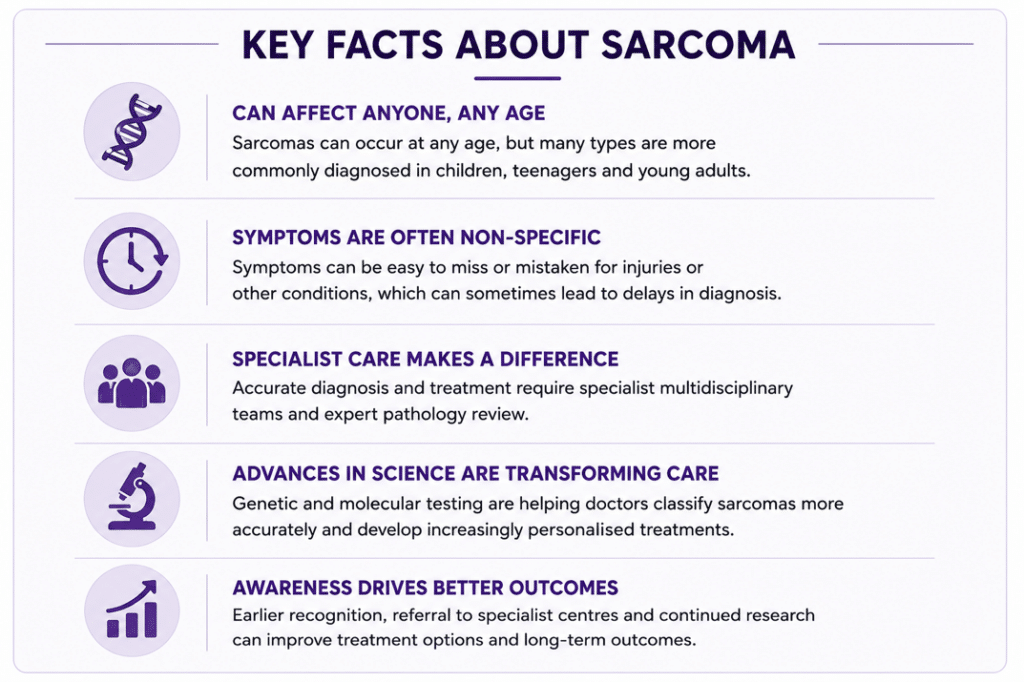
One of the greatest challenges associated with sarcoma is that the symptoms are often non-specific. Many people initially experience what appears to be a sports injury, muscle strain, persistent ache or a painless lump. Because these symptoms are far more likely to be caused by common conditions than by cancer, sarcoma is often not suspected immediately.
The rarity of sarcoma also means that many clinicians working outside specialist cancer centres may encounter very few cases throughout their careers. This makes awareness particularly important. While most lumps and persistent pain are not caused by sarcoma, symptoms that continue to grow, worsen or fail to resolve should always be assessed by a healthcare professional. Earlier diagnosis increases the likelihood of treatment before the disease has spread and often improves both treatment options and long-term outcomes.
Diagnosis requires specialist expertise
Diagnosing sarcoma involves much more than identifying a tumour on a scan. Patients are usually assessed using a combination of imaging techniques, including ultrasound, MRI, CT and, in some cases, PET scans. These investigations help determine the size, location and extent of the tumour.
A biopsy is essential to confirm the diagnosis. Specialist pathologists examine the tissue under the microscope and increasingly use advanced molecular techniques to identify genetic changes within the tumour. DNA sequencing, RNA sequencing and fusion gene testing now play an important role in accurately classifying many sarcomas and, in some cases, identifying patients who may benefit from targeted therapies or clinical trials.
Because sarcomas are uncommon and often complex, diagnosis is best undertaken in specialist sarcoma centres with multidisciplinary teams that include radiologists, pathologists, surgeons, medical oncologists, radiation oncologists, specialist nurses and allied healthcare professionals.
A future driven by research
Research has transformed the understanding of sarcoma over the past two decades. Scientists now recognise that many sarcomas are driven by specific molecular alterations rather than simply where they develop within the body. This has led to significant advances in diagnostic accuracy and is paving the way for precision medicine, where treatments are increasingly tailored to the biology of an individual’s tumour.
International collaboration has also accelerated progress. Clinical trials continue to evaluate new chemotherapy combinations, targeted medicines, immunotherapies and advanced radiotherapy techniques, while researchers investigate biomarkers that may help predict treatment response and improve survival. Although sarcoma remains a rare cancer, the pace of scientific discovery continues to grow. Every advance brings us closer to more effective treatments, fewer long-term side effects and, ultimately, better outcomes for patients of all ages.
Why awareness matters
Sarcoma is rare, but for the families affected by it, rarity offers little comfort. Earlier diagnosis can improve treatment options. Increased awareness helps families recognise warning signs sooner, encourages timely referral to specialist centres and supports continued investment in research that could transform future outcomes. Every conversation about sarcoma helps break the silence surrounding this disease. Every research study brings us closer to more effective treatments. Every act of fundraising supports scientists, clinicians and healthcare teams working to improve survival and quality of life.
At the Harry Kazmi Foundation, we believe that every child and young person deserves access to the very best care, the latest scientific advances and the hope that continued research can bring. By raising awareness, supporting research and standing alongside families, we can help ensure that more young people diagnosed with sarcoma have the opportunity not only to survive but to thrive.
Because every young life deserves a future.