
By Emily Carter – PhD Student in Oncology and Health Advocacy Volunteer, The Harry Kazmi Foundation
Closing the awareness gap in rare cancers
Most people can name several forms of cancer without hesitation. Breast cancer, lung cancer, leukaemia, and skin cancer are all deeply embedded within public awareness through news headlines, charity campaigns, fundraising initiatives, and everyday conversation. Over time, these diseases have become widely recognised, not because people wish to become familiar with them, but because society has invested heavily in ensuring they are seen, discussed, and understood.
Sarcoma, however, remains largely unknown to much of the public. For many people, it is a word they encounter for the very first time only after it becomes deeply personal, arriving suddenly within a hospital consultation, a scan result, or a conversation capable of changing life in an instant. That lack of awareness matters because understanding sarcoma, recognising its warning signs, and reaching specialist diagnosis earlier can make a profound difference to the lives of patients and families facing these rare cancers.
A cancer with no fixed address A cancer with no fixed address
Most cancers are understood through the organ or system in which they originate. Sarcoma, however, does not follow the same pattern. Rather than developing within a single organ, sarcoma arises in the connective tissues of the body, the structures responsible for supporting, connecting, and protecting everything else. Muscle, fat, tendons, blood vessels, nerves, cartilage, and bone all fall into this category, which means sarcoma has the potential to develop almost anywhere within the body.
This is one reason diagnosis can be so challenging. There is no single location to monitor, no routine scan specifically associated with the disease, and often no immediately obvious place to investigate first. Adding further complexity, sarcoma is not a single cancer but a broad family of more than 70 recognised subtypes, each behaving differently and often requiring entirely different treatment approaches. Some progress slowly over many years, while others are highly aggressive, spreading early and rapidly. Some are seen predominantly in older adults, while others disproportionately affect children, teenagers, and young adults at some of the most formative stages of life.
The two broad categories are soft tissue sarcoma, which develops in muscles, fat, and related tissues, and bone sarcoma, which originates within the bones themselves. Within both groups lies enormous biological complexity, which is part of why sarcoma remains difficult to diagnose, research, and treat, even once identified.
When symptoms look like something else
One of the most troubling aspects of sarcoma is how ordinary the early signs can appear. Symptoms often resemble the kinds of issues people experience routinely in everyday life, making them easy to dismiss or misinterpret. A lump may appear similar to a minor sports injury, persistent discomfort may feel no different from muscular strain or post exercise pain or swelling can develop gradually and seem harmless for weeks or even months.
Because these symptoms are so common, and because sarcoma itself is comparatively rare, the disease frequently does not immediately appear on anyone’s radar, not the patients, and not always the first clinician’s either. For soft tissue sarcomas, early signs often include a lump or swelling that continues growing over time, discomfort caused by pressure on muscles or nerves, or a gradual reduction in movement around a limb or joint. Bone sarcomas may present through persistent bone pain, swelling near a joint, worsening night pain, or, in more serious cases, an unexpected fracture.
Most lumps and persistent pains are not cancer, and it is important to state that clearly because the purpose of awareness is not to create fear but to encourage appropriate attention and timely investigation. Medical professionals generally advise that any lump which is growing, painful, larger than roughly five centimetres, or positioned deep within tissue should be properly assessed rather than simply monitored over time.
The difficulty is that without broader public understanding of sarcoma, many people do not know when to push for further investigation. Reassurance is accepted, symptoms are observed at home, and valuable time can quietly pass before specialist assessment is eventually reached.
Alveolar Rhabdomyosarcoma (ARMS): A diagnosis that changes everything
Within the broad family of sarcomas, one subtype deserves particular attention: Alveolar Rhabdomyosarcoma, often referred to as ARMS. This rare and aggressive cancer develops from immature cells associated with skeletal muscle tissue and primarily affects children, teenagers, and young adults. While rhabdomyosarcoma itself represents only a small proportion of childhood cancers, alveolar rhabdomyosarcoma is rarer still, meaning many families encounter the disease for the very first time only after diagnosis.
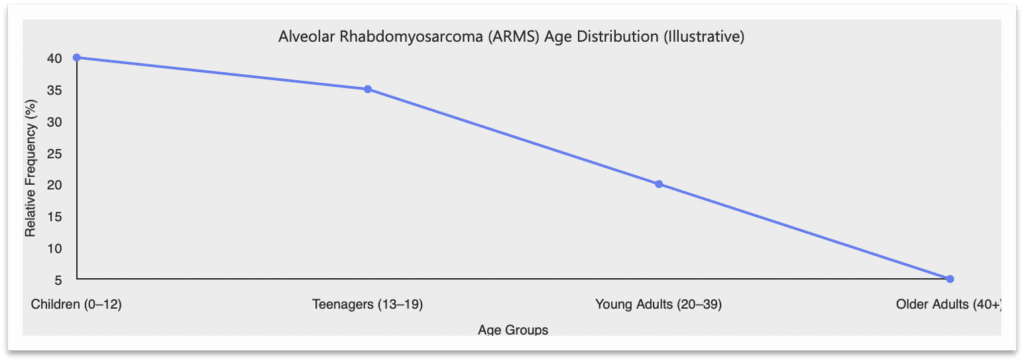
Alveolar rhabdomyosarcoma disproportionately affects children, teenagers, and young adults, with significantly lower incidence in older adults. This reinforces the urgent need for awareness in younger populations where cancer is often least expected.
The term “alveolar” originates from the appearance of the tumour cells under a microscope. Pathologists observed that the cells often form small spaces or patterns resembling alveoli, the tiny air sacs found within the lungs. Despite the name, ARMS does not usually begin in the lungs themselves but instead develops from early cells that would normally go on to become skeletal muscle tissue.
Unlike many adult cancers, ARMS is generally not associated with lifestyle or environmental factors. Families searching desperately for explanations frequently discover there is no clear answer because the disease is usually driven by spontaneous genetic abnormalities within cells rather than anything else. In many cases, ARMS is linked to specific fusion of genes which helps drive the aggressive behaviour of the tumour.
ARMS can develop in the arms, legs, chest wall, abdomen, pelvis, head and neck region, with symptoms varying depending on tumour location. Some patients notice what appears to be a painless lump, while others experience breathing difficulties, restricted movement, swelling, or increasing pain as the tumour grows and begins affecting surrounding structures.
What makes ARMS particularly difficult is its tendency to grow rapidly and spread earlier than many other sarcomas. By the time diagnosis occurs, some patients may already have metastatic disease involving the lungs, bone marrow, lymph nodes, or other areas of the body. In this context, speed of diagnosis is not simply beneficial but critical, because every week can matter in ways that are difficult to overstate.
The Road to Diagnosis and Treatment
Confirming a sarcoma diagnosis is rarely straightforward. Once sarcoma becomes suspected, imaging tests such as CT, MRI, PET scans, and ultrasound are used to build a clearer clinical picture. Imaging alone, however, cannot confirm the disease. A biopsy, where a small tissue sample is removed and examined by specialist pathologists, is required to accurately identify the subtype involved.
This level of precision matters enormously because treatment pathways vary significantly depending on the exact form of sarcoma being treated. Care is usually coordinated through a multidisciplinary team involving oncologists, surgeons, radiologists, pathologists, urologists, physiotherapists, specialist nurses, and other clinicians who work together to determine the most appropriate treatment approach.
Treatment commonly involves a combination of surgery, chemotherapy, and radiotherapy delivered over many months. For aggressive sarcomas such as ARMS, the process can become physically exhausting and emotionally overwhelming, particularly for children, teenagers, and young adults who suddenly find themselves navigating repeated scans, invasive procedures, long inpatient stays, high dose intense chemotherapy, surgery, and prolonged uncertainty at precisely the stage of life that should otherwise be focused on education, friendships, careers, and independence.
The impact extends far beyond the patient themselves. Families often carry enormous emotional and physical pressures throughout the process as parents become carers and advocates, siblings adapt to entirely different family realities, and daily life becomes increasingly shaped by appointments, treatment schedules, waiting rooms, recovery periods, and uncertainty about what comes next.
Rare cancers do not simply enter one person’s life. They reshape the lives of entire families.
The Harry Kazmi Foundation
The foundation was established through the lived experience of 17-year-old Harry Kazmi’s ongoing journey with alveolar rhabdomyosarcoma, with a mission to help raise awareness of rare and aggressive childhood cancers that remain largely unknown to the public.
The foundation exists to support greater understanding of alveolar rhabdomyosarcoma and other fusion positive sarcomas, while helping drive awareness, education, research collaboration, advocacy, and support for young people and families facing these diseases. Through its work, the foundation aims to help connect healthcare, science, academia, industry, philanthropy, and community, recognising that progress in rare childhood cancers requires far greater collaboration across disciplines and sectors.
At the heart of the foundation is Harry’s belief that greater awareness can lead to earlier recognition, faster diagnosis, stronger support networks, increased research attention, and ultimately better outcomes for young people facing these cancers.
Sarcoma may be rare, but for the families living through it, the impact is life changing.
Contact: support@hkfoundation.org.uk